


Morocco has long been celebrated for its rich cultural heritage, dazzling architecture, and centuries-old traditions. Its intricate tilework, colorful textiles, and ornamental patterns have inspired artists and designers worldwide. From fashion houses to interior decorators, the spirit of Morocco has often found expression in the world of luxury. Yet beyond fabrics and design, Morocco’s influence extends into one of horology’s most fascinating stories—the creation of Cartier’s iconic Pasha watch.
Unlike other tales of Moroccan influence in global luxury, this one does not begin with Yves Saint Laurent’s legendary love affair with Marrakech or with the countless designers who draw upon Moroccan craftsmanship. Instead, it begins with a powerful historical figure: Thami El Glaoui, the Pasha of Marrakech, whose extraordinary life would lead to one of Cartier’s most enduring creations.
The Pasha of Marrakesh: Lord of the Atlas.
Thami El Glaoui was no ordinary man. Rising to prominence in 1912, with the arrival of the French protectorate in Morocco, he became one of the most influential and wealthiest figures in the country. His strategic alliance with the French earned him vast tracts of land, mining rights, and political power. Historian Maâti Monjib explains that El Glaoui controlled “several thousand hectares and tens of millions of francs deposited in banks in Morocco and France, especially in Banque ParisBas.”
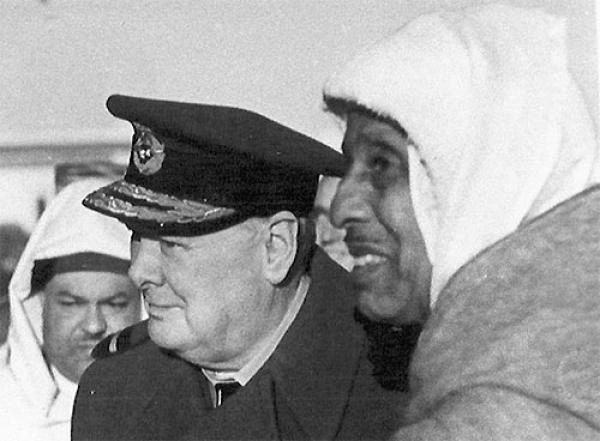
His immense wealth earned him the nickname “Lord of the Atlas,” given by Hubert Lyautey, the French Resident-General of Morocco who was effectively running the Kingdom of Morocco on behalf of the French Government. The Glaoui family resided in sumptuous palaces filled with European furniture, Baccarat crystal, and ornate silverware. Their salons regularly hosted diplomats, celebrities, and even royalty. Winston Churchill, who loved Marrakech, was a guest of the Pasha and painted several canvases while staying at his palaces. El Glaoui’s life was one of unabashed grandeur, with each gesture designed to reflect power, refinement, and excess.
A Watch Born of Luxury and Necessity
By the early 1930s, the Pasha was at the height of his influence. Known for his daily rituals, he had a penchant for long baths and frequent swimming—a lifestyle that posed a challenge to traditional wristwatches of the era, which were not designed for water resistance.
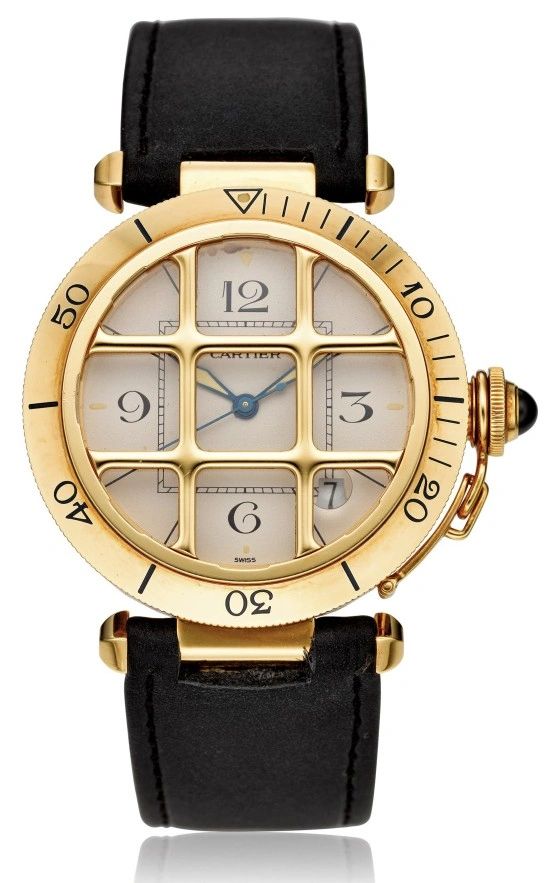
In 1931, Thami El Glaoui commissioned Louis Cartier, the grandson of the brand’s founder, to create a special watch: a robust yet elegant timepiece that could withstand water while maintaining Cartier’s refined aesthetic. Cartier responded by designing a remarkable round gold watch with a screw-down case, a protective grid across the dial, and a cap over the crown secured by a tiny chain.
This bespoke creation would not remain just a one-off. The design became the seed for what would later evolve into one of Cartier’s most recognizable collections: The Pasha de Cartier.
The Lost Watch and Its Mystique
The very first Pasha watch, created specifically for Thami El Glaoui, carried a unique story of its own. Crafted in solid 18-carat gold and engraved with the number 1, it was both a statement of power and a marvel of early waterproof engineering. But history is often unkind to symbols of excess.
In the 1950s, with the rise of Morocco’s nationalist movement and the end of the French protectorate, El Glaoui fell from power. Branded a collaborator, he was stripped of his influence and wealth. Amid the turbulence, his possessions were scattered—and the original Cartier Pasha was lost to history.
For Cartier, the absence of this watch has only deepened its mystique. In a 2003 interview, Stanislas de Quercize, then President and CEO of Cartier North America, admitted: “We hope to find it and buy it back.” To this day, the whereabouts of the first Pasha remain unknown, fueling speculation among collectors and watch historians.
The Quartz Crisis and Cartier’s Revival
Fast forward to the late 20th century. The Swiss watch industry was facing unprecedented challenges: the quartz crisis, rising oil prices, and a global economic downturn had shaken the world of traditional watchmaking. It was during this turbulent period that Alain-Dominique Perrin, CEO of Cartier from 1975 to 1998, stepped in with bold ideas.

Perrin understood that survival meant innovation. He capitalized on the success of “Les Must de Cartier” (a diffusion line launched in 1977 that brought Cartier to a wider audience) and, in 1978, introduced the Santos de Cartier, a sportier, more accessible wristwatch. This move positioned Cartier as a serious player in the evolving market, dominated by steel luxury sports watches like the Audemars Piguet's Royal Oak and Patek Philippe's Nautilus.
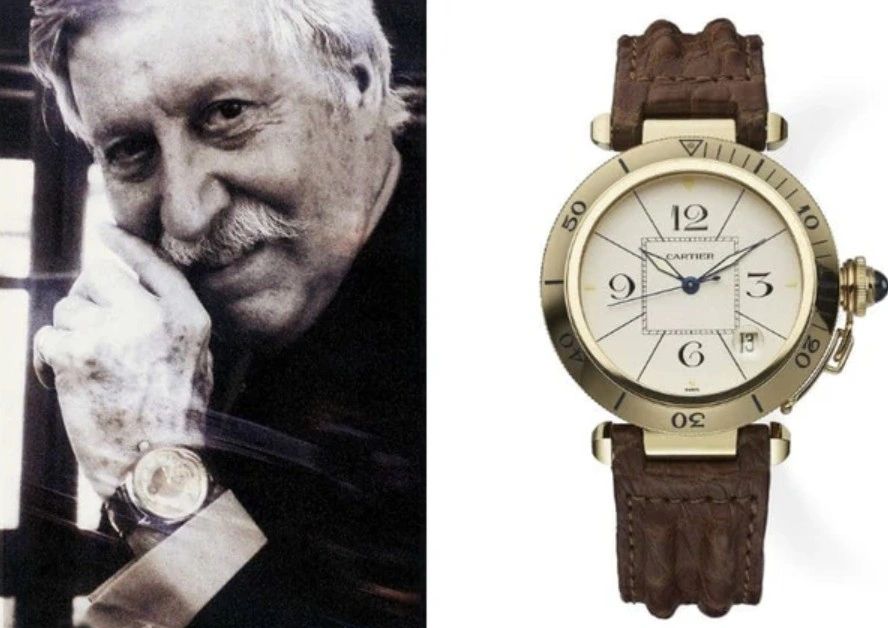
By 1985, Cartier was ready for something bigger: a masculine, waterproof luxury watch that could stand alongside icons like the Rolex Submariner but retain Cartier’s elegance. To achieve this, Perrin turned to none other than Gérald Genta, the legendary watch designer who happened to be behind both the Nautilus AND the Royal Oak. The result was the rebirth of the Pasha de Cartier, a watch that broke away from Cartier’s traditional rectangular and oval shapes with its bold round case.
The 1985 Pasha: Bold, Sporty, Elegant
The 1985 Pasha was unlike anything Cartier had produced before. It came with a large 38 mm case (considered oversized at the time), a broad bezel, distinctive Vendôme lugs, and the now-iconic screw-down crown cover attached by a chain. The dial carried Cartier’s unmistakable design codes: a central square minute track inside a circular dial, bold Arabic numerals at 12, 3, 6, and 9, and a sense of sporty elegance that resonated with the era.
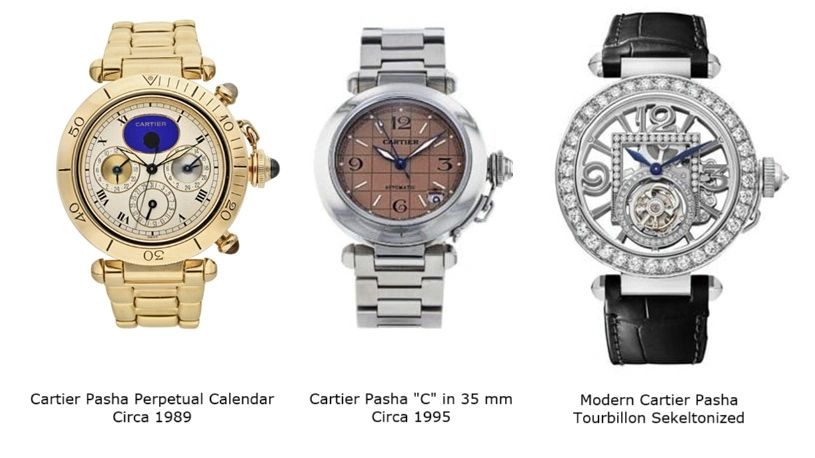
Soon after, Cartier expanded the line with automatic models featuring complications—chronographs, GMTs, moonphases, even perpetual calendars—each carrying elements of the original Pasha’s DNA.
1990: The Steel Pasha
For its first five years, the Pasha collection was reserved for precious metals, reinforcing its exclusivity. But in 1990, Cartier introduced the Pasha in stainless steel. With the same 38 mm case and distinctive crown cover, the steel version made the watch more versatile and broadened its appeal.
Powered by a reliable ETA movement, the steel Pasha embodied the sporty promise of the original design, while remaining elegant enough to wear in any setting. It was robust, more accessible, and became a favorite among collectors who wanted the Pasha look without the full weight of gold.
A Lasting Legacy
From its origins in the palaces of Marrakech to its rebirth during the turbulence of the quartz crisis, the Cartier Pasha has traveled an extraordinary journey. It is a watch that speaks not only of luxury but also of resilience, adaptability, and bold design.

Today, whether in sleek steel versions, gem-set haute horlogerie models, or modern reinterpretations, the Pasha remains one of Cartier’s most distinctive creations. It carries with it the memory of a Moroccan ruler, the vision of Alain-Dominique Perrin, the genius of Gérald Genta, and the elegance that has always defined Cartier.
The legend continues: a watch born in Morocco, revived in Switzerland, and admired around the world.
Article written by Mehdi, a collaborator to The Watch Curators


